Case study · Volunteer management SaaS

Bénévènement — from a festival spreadsheet to online software

Bénévènement is volunteer management software for events: a form where everyone picks their shifts, spots counted live, printable rosters per station and group emails. It is our product, not a client’s: we designed it, we develop it and we run it.

It did not come out of a design workshop. It first served a real festival, with real volunteers, before being opened to others — and that origin explains most of the decisions below.

Visit the live site(benevenement.fr, new window)
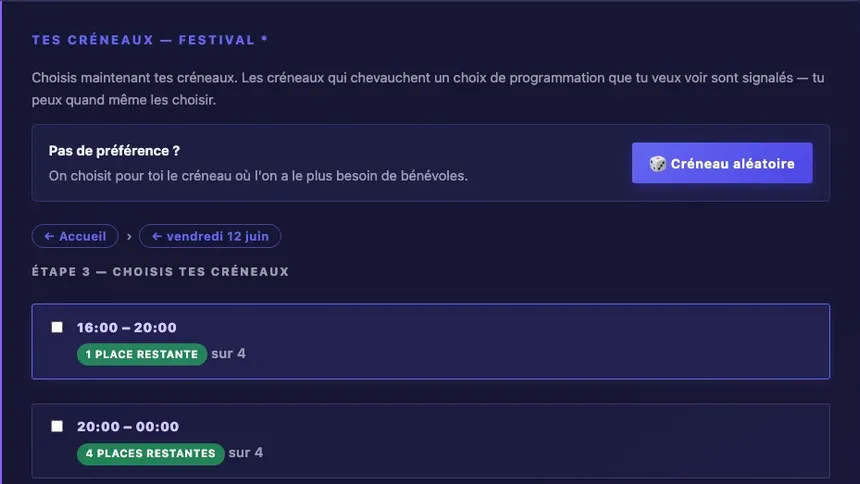
Volunteer sign-up form showing shifts and remaining spots — Bénévènement, volunteer management software

The starting point: a shared spreadsheet

At the Phare Ouest’Ival festival, whose website we also built, volunteers were managed the way many non-profits manage them: in a shared spreadsheet. Availability came in by email, by text, by private message, and the up-to-date version only existed in the head of whoever was copying it over.

In spring 2026, we wrote the tool that was missing. It handled sign-ups for the 2026 edition: 83 volunteers and 189 shifts, from set-up to tear-down. Bénévènement takes its core and makes it configurable, so that a race, a trade fair or a village fête can use it without seeing a single word of festival vocabulary.

The four decisions that shape the product

The rules apply at sign-up, not the night before

Remaining spots are shown shift by shift, a full shift closes, and two overlapping shifts cannot be taken by the same person. What a spreadsheet lets through, only to be discovered at the briefing, is refused the moment the volunteer clicks.

The tool knows the line-up

Concerts, races or talks are entered with their times: the tool flags a volunteer assigned during the one they wanted to see. That is what brings people back the following year, and it is something a generic tool cannot do. With no line-up, the module switches off.

Paper remains the medium on the day

One roster per station, with its lead and their phone number, ready to print. At the security desk or along a trail course, the network does not always reach: the organisation has to hold without it, and that was designed in from the start rather than left to a spreadsheet export reformatted by hand.

A price per edition, never per month

A non-profit votes a budget per event, not a subscription for the ten months when nothing happens. The first edition is free in full, with no card, rather than for fourteen days: a time-limited trial usually ends before volunteer sign-ups have even started.

What the product does

  • A public sign-up form, with no account for volunteers to create: remaining spots in real time, full shifts closed, overlaps refused, confirmation by email.
  • A back office per event: stations, phases, shifts and capacities, fill-rate tracking, and an alert when a volunteer is assigned during a moment of the line-up.
  • Printable rosters per station, day by day, with the lead’s name and phone number.
  • Emails: an individual summary at sign-up, then messages to everyone, to a selection or to a whole station, personalised with the first name.
  • Custom form fields — short text, long text, choice list, checkbox — along with the event’s logo, colours and vocabulary.
  • Three roles: administrator, station lead and read-only. A lead only sees their station and only writes to their volunteers.
  • Carrying an edition over to the next in one form: stations, leads, phases and shifts copied, dates shifted in one go. Volunteers, on the other hand, are never copied.
  • Data hosted in the European Union, separated per event, exportable as CSV and deletable.
  • A marketing site with one page per type of event — festival, race or trail, fair or forum —, public pricing, and the software declared to Google with its features, offers and FAQ.

What that gives, measured

The application sits behind a login; what can be measured publicly is the marketing site, the page through which an organiser discovers the tool. The figures below were taken there under the conditions of a phone on an average network.

0.9 s

Largest Contentful Paint (LCP)

Google considers a site fast below 2.5 s.

0

Cumulative Layout Shift (CLS)

Nothing moves while the page loads. The penalty threshold is 0.1.

5

Network requests

All to the site itself: no third-party domain called.

55 KB

Page weight

The three screenshots of the tool are only loaded on scroll, when you reach them.

Measured on 23 September 2026 on the benevenement.fr home page — mobile emulation, network capped at 1.6 Mbit/s with 150 ms latency, CPU slowed four times, median of three runs.

These measurements describe the site on the day they were taken. They move when the content moves: that is why the date is written next to them.

What it makes possible

What the product allows, by design. These are not reported results but consequences of its features and terms, as published on benevenement.fr.

Trying it on a real event, without signing anything

The workspace opens online, with no approval to wait for and no card, and the first edition is complete: no limit on volunteers or duration. An organiser judges the tool on their own edition, not on a demo.

Delegating a station without handing over every key

Because roles are separated, the bar lead manages their team and writes to it directly, without access to the contact details of every other volunteer.

The volunteer file stops circulating

Names, phone numbers and emails stay in the tool, per edition, instead of travelling as attachments through six inboxes. They can be exported and deleted whenever the organisation decides.

The next edition starts from the previous one

For an annual event, stations, leads and shifts carry over in one form. Only the volunteers start from scratch: a sign-up is for one edition, and renewing it would mean committing people without asking them.

A project along these lines?

Tell us where you stand. We reply within two working days, and the first conversation costs nothing.